Why “Good Enough” Digital Banking Isn’t Enough Anymore
In the financial world, the bar for great customer experiences is constantly rising. Those increasing expectations are clear in corporate banking, and the effects are having a major impact.
Clients now expect seamless, self-directed experiences that mirror the best personal finance offerings. And this is causing corporate banking clients to move to digitally-led banks who can offer this kind of technology-enabled experience.
But why is this happening?
The expectation shift
Two forces are driving the change:
- Changing demographics: Millennials now make up a large majority of B2B buyers — a cohort accustomed to speed and autonomy. Self-service through digitalisation is an important aspect of how they do business, helping them to achieve the results they need, when they need it.
- Spillover from retail: corporate banking clients have also experienced digitally-led banks like Monzo, Revolut and Starling, which has influenced their expectations to be able to access information in a single, seamless digital interface.
Business-as-usual vs. intelligent engagement
Business-as-usual (BAU)
Often the biggest blocker to evolution is the fear of evolution itself. But at this moment in time, corporate banks face a real existential threat if they stand still, while their competitors move forward. A business-as-usual approach means an experience that risks delivering:
- Fragmented channels; manual handoffs; passive data; IT-centred change
- Slower onboarding
- High admin overheads
- And the customer experience bears the cost of these issues: friction and delays across onboarding, applications, and services – leading, ultimately, to them exploring more digitally mature competitors.
Intelligent engagement
Intelligent engagement means creating a digitally-augmented way of engaging corporate clients, based on a harmonised set of processes within the bank. When building this, there a few priority areas to focus on:
- Creating a retail-like, one-stop-shop experience with role-aware orchestration and faster onboarding. Your plans should focus on where value is visible; transform client-facing moments first (onboarding is a strong candidate), then iterate into internal processes.
- Building internal processes designed to power the front end. This means clear, mapped processes sharing information across different teams within banks, minimising lost and repeated customer information requests.
- And using a low/no-code front-end combined with modular, API-first platforms, allowing banks to assess, improve and extend the capabilities of the customer experience in a singular, digital environment.
The last factor that intelligent engagement must consider is how customers want to engage. Despite the push towards digital experiences, human relationships are still important for many corporate clients, so digitally-led journeys should be complemented by advisory services to help with complex tasks.
Intelligent engagement’s impact on the customer experience and ROI
The last factor that intelligent engagement must consider is how customers want to engage. Despite the push towards digital experiences, human relationships are still important for many corporate clients, so digitally-led journeys should be complemented by advisory services to help with complex tasks.
With a planned and prioritised approach, combining these intelligent engagement foundations doesn’t just benefit internal processes, but pushes the advantages onto customers themselves. The result? Banks that focus on upgrading their digital maturity in a targeted, strategic way, see an almost immediate return on investment.
It means that they have access to a single, digital space for all of their needs, from document management and qualified electronic signatures through to identity verification.
A centralised customer experience, powered by technology but with that human element too, also improves compliance, auditability and accessibility.
So for both banks and corporate clients, there is a positive impact on the time spent and overall costs. More autonomy and self-service, based on a comprehensive, streamlined process and data foundation, means value is achieved faster.
it’s not about adding another feature or channel, but about orchestrating how work flows across people, systems and customers — so the right task reaches the right person at the right moment, with everything tracked and auditable.
The new mandate: partner, not just provider
The endgame isn’t more screens; it’s deeper client partnership.
“Now clients are saying that they don’t want a service, they want a partner… they need someone to take that journey with them.” was how a top 5 global bank explained it to us.
Intelligent engagement creates that partnership: synchronised information, automated systems, reduced repetition and a compliant, auditable, self-service-enabled environment — with experts in the loop when it counts.
Good enough is no longer sufficient, because your customers already know what great feels like elsewhere. The banks that close that gap first will set the standard for everyone else.
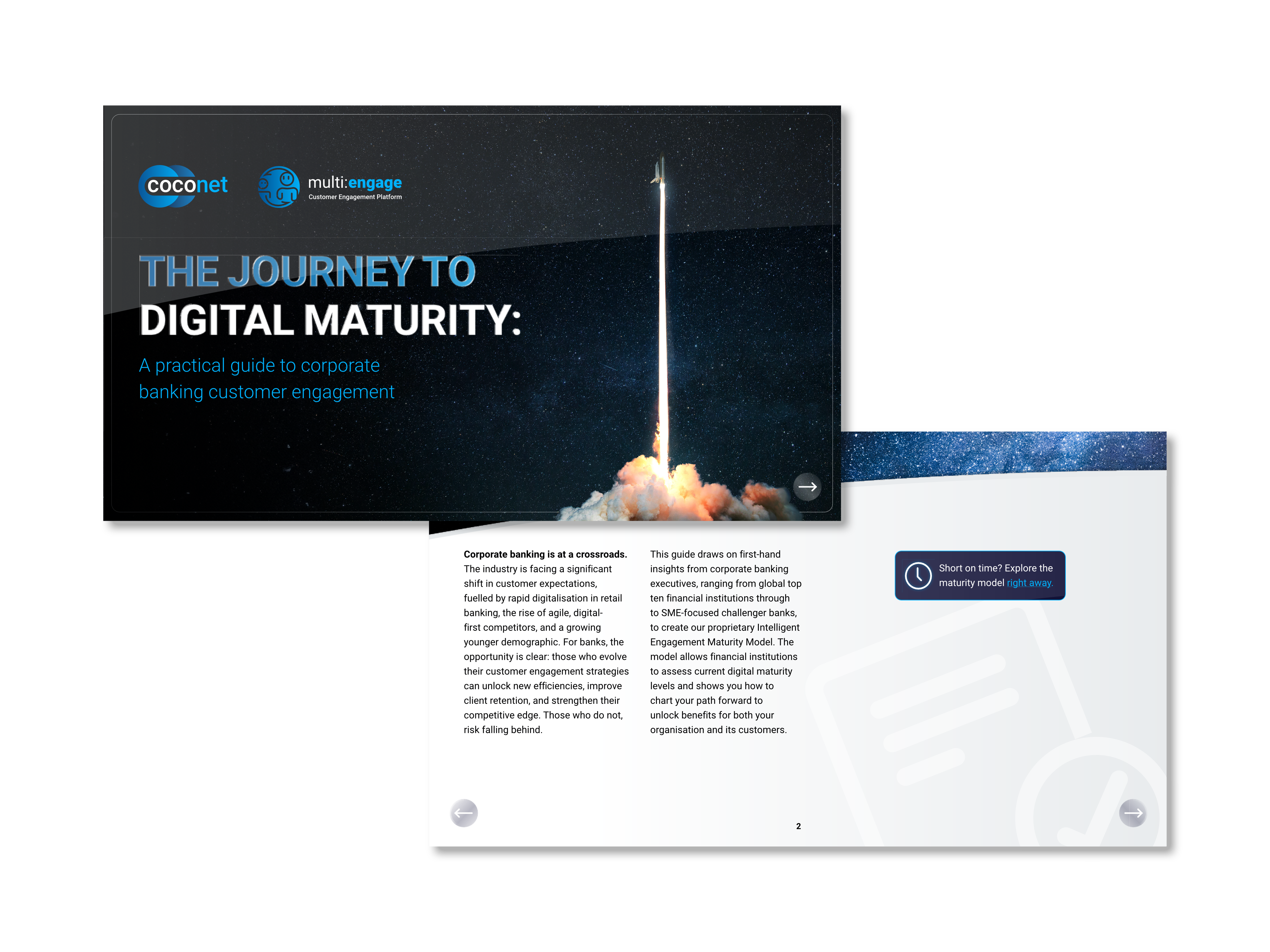
Explore how Europe’s top banks are rethinking digitally-led engagement in our new guide, The Journey to Digital Maturity: A Practical Guide to Corporate Banking Customer Engagement. The report overviews the corporate banking landscape, sets out the clear levels of digital maturity, the impact of each on customer experiences, and gives you the blueprint to improve your digital offerings.